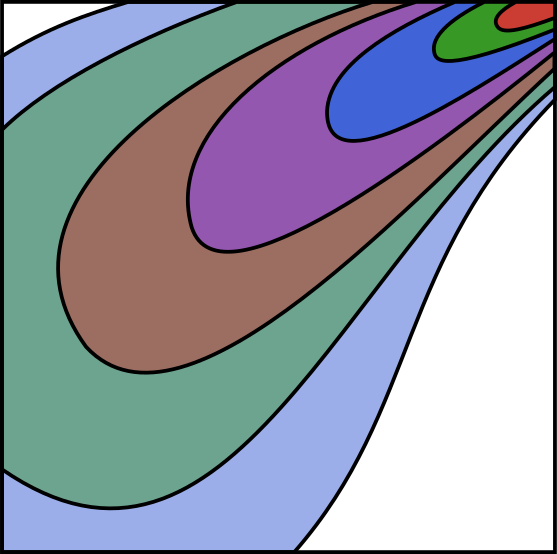
Empirical Kendall function and Archimedean's λ function.
The Kendall function is important in dependence structure analysis. The Kendall function associated with a
From a computational point of view, we often do not have access to true observations of the random vector
Indeed,
struct KendallFunction{T}
    z::Vector{T}
    function KendallFunction(x)
    d,n = size(x)
    z = zeros(n)
    for i in 1:n
        for j in 1:n
            if j ≠ i
                z[i] += reduce(&, x[:,j] .< x[:,i])
            end
        end
    end
    z ./= (n-1)
    sort!(z) # unnecessary
    return  new{eltype(z)}(z)
    end
end
function (K::KendallFunction)(t)
    # Then the K function is simply the empirical cdf of the Z sample:
    return sum(K.z .≤ t)/length(K.z)
end
Let us try it on a random example:
using Copulas, Distributions, Plots
X = SklarDist(ClaytonCopula(2,2.7),(Normal(),Pareto()))
x = rand(X,1000)
K = KendallFunction(x)
plot(u -> K(u), xlims = (0,1), title="Empirical Kendall function")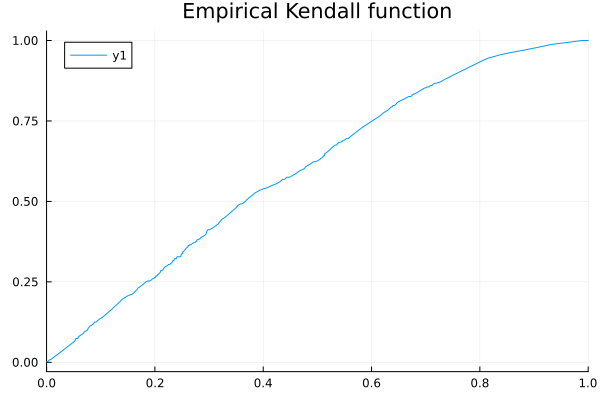
We can also visualize the ECDF of the intermediate variables Z (whose empirical CDF is K):
using StatsBase
EC = ecdf(K.z)
plot(t->EC(t); label="ECDF of Z", xlabel="t", ylabel="K_N(t)")
plot!(t->K(t); label="K(t)", color=:red, alpha=0.6)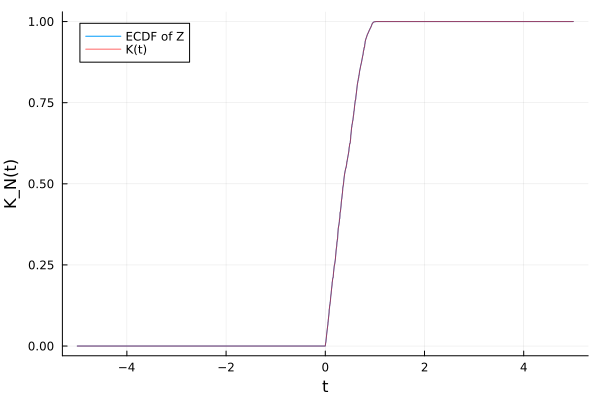
One notable detail about the Kendall function is that it does not characterize the copula in all generality. On the other hand, for an Archimedean copula with generator φ, we have:
Due to this particular relationship, the Kendall function actually characterizes the generator of the Archimedean copula. This relationship is generally expressed in terms of a λ function defined as
Common λ functions can be easily derived by hand for standard archimedean generators. For any archimedean generator in the package, however, it is even easier to let Julia do the derivation.
Let's try to compare the empirical λ function from our dataset to a few theoretical ones. For that, we setup parameters of the relevant generators to match the kendall τ of the dataset (because we can). We include for the record the independent and completely monotonous cases.
using StatsBase: corkendall
plot(u -> u - K(u), xlims = (0,1), label="Empirical λ function")
κ = corkendall(x')[1,2] # empirical kendall tau
θ_cl = 2κ / (1 - κ)
θ_gu = 1 / (1 - κ)
λ_cl(u) = (u^(1 + θ_cl) - u) / θ_cl
λ_gu(u) = u * log(u) / θ_gu
plot!(λ_cl, label="Clayton")
plot!(λ_gu, label="Gumbel")
plot!(u -> 0, label="Comonotony")
plot!(u -> u*log(u), label="Independence")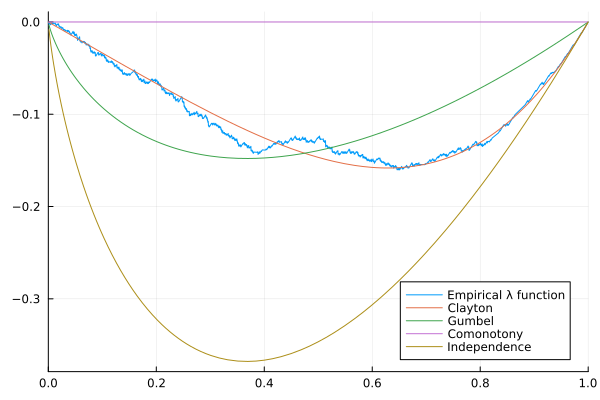
Smaller samples increase the variability of the empirical λ function. For illustration:
Xsmall = SklarDist(ClaytonCopula(2,2.7),(Normal(),Pareto()))
x2 = rand(Xsmall, 300)
K2 = KendallFunction(x2)
plot(u -> u - K(u), xlims=(0,1), label="N=1000")
plot!(u -> u - K2(u), label="N=300")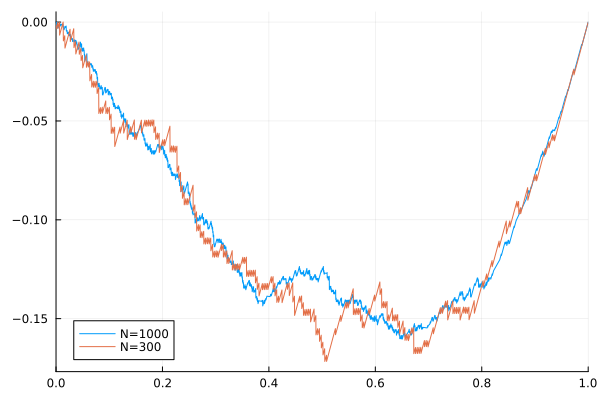
The variance of the empirical λ function is notable in this example. In particular, we note that the estimated parameter
θ_cl2.9737620361058283is not very far for the true
Empirical validation of the Archimedean property of the data
Non-parametric estimation of the generator from the empirical Kendall function, or through other means
Non-Archimedean parametric models