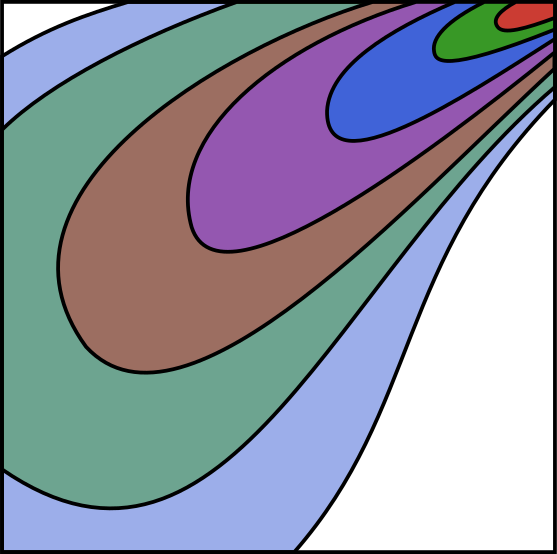
Extreme Value family
Extreme-value copulas are max-stable dependence models used throughout multivariate extreme-value theory. In dimension
The natural dimension-free representation is the stable tail dependence function (STDF)
A valid STDF is convex and one-homogeneous and satisfies
By homogeneity,
to obtain the multivariate Pickands dependence function
with
What is specifically bivariate is the scalar parametrization of the simplex. For
where
Accordingly, Copulas.jl uses the STDF
The bivariate copula therefore has the classical representation
Bivariate and multivariate EV copulas
Copulas.jl uses
Choose the family, not the algorithm
A public constructor identifies the mathematical family. It does not ask the user to choose a bivariate or multivariate numerical algorithm.
What is new in the EV subsystem?
The current EV implementation goes beyond the historical bivariate-only design:
the core representation is a dimension-aware STDF
ℓ;several classical EV families now use the same public constructor in
and ; a few matrix and vector parameterizations infer the dimension when a single parameter determines it immediately;
general Hüsler-Reiss variograms and extremal-
correlation matrices are supported in addition to exchangeable submodels; Tawn and asymmetric Galambos expose structured multivariate subset parameterizations;
BC2 and Marshall-Olkin have multivariate spectral/shock representations;
multivariate empirical EV estimation is available through a shape-constrained discrete spectral projection;
multivariate densities and exact sampling are available for the documented families.
Constructors and dimensional conventions
The canonical constructor always makes the dimension part of the type:
FamilyCopula{d}(params...)The equivalent runtime-dimension form
FamilyCopula(d, params...)is convenient but is not type-stable with respect to d.
No implicit bivariate dimension for scalar parameters
Scalar/exchangeable EV families require an explicit dimension. For example, write GalambosCopula{2}(2.3) or GalambosCopula(2, 2.3); GalambosCopula(2.3) is intentionally not a constructor.
Scalar or exchangeable families therefore have canonical forms
LogCopula{d}(θ)
GalambosCopula{d}(θ)
MixedCopula{d}(θ)
CuadrasAugeCopula{d}(θ)
HuslerReissCopula{d}(θ)
tEVCopula{d}(ν, ρ)
with FamilyCopula(d, ...) as runtime sugar.
Structured parameterizations follow exactly the same rule:
HuslerReissCopula{d}(Γ)
tEVCopula{d}(ν, R)
TawnCopula{d}(α, weights)
AsymGalambosCopula{d}(α, weights)
BC2Copula{d}(a)
MOCopula{d}(λ)
EmpiricalEVCopula{d}(U)
Because these objects determine their own dimension, the following additional convenience forms are also available:
HuslerReissCopula(Γ)
BC2Copula(a)
MOCopula(λ)
EmpiricalEVCopula(U)
The full subset representations are likewise available as
TawnCopula{d}(dep, asy)
AsymGalambosCopula{d}(dep, asy)
together with FamilyCopula(d, dep, asy).
| Family | Canonical constructor | Supported dimension | Interpretation |
|---|---|---|---|
| Logistic | LogCopula{d}(θ) | exchangeable | |
| Galambos | GalambosCopula{d}(θ) | exchangeable negative logistic | |
| Mixed | MixedCopula{d}(θ) | scalar Copulas.jl extension of the bivariate mixed model | |
| Cuadras-Augé | CuadrasAugeCopula{d}(θ) | scalar | |
| Hüsler-Reiss | HuslerReissCopula{d}(θ) | exchangeable variogram | |
| Hüsler-Reiss | HuslerReissCopula{d}(Γ) | general variogram | |
| extremal- | tEVCopula{d}(ν, ρ) | equicorrelation | |
| extremal- | tEVCopula{d}(ν, R) | general correlation matrix | |
| Tawn | TawnCopula{d}(α, weights) | full-set logistic component + singleton remainders | |
| Tawn | TawnCopula{d}(dep, asy) | full subset representation | |
| Asymmetric Galambos | AsymGalambosCopula{2}(α, θ₁, θ₂) | 2 | bivariate form of the unified subset model |
| Asymmetric Galambos | AsymGalambosCopula{d}(α, weights) | full-set negative-logistic component + singleton remainders | |
| Asymmetric Galambos | AsymGalambosCopula{d}(dep, asy) | full subset representation | |
| BC2 | BC2Copula{2}(a, b) | 2 | classical bivariate representation |
| BC2 | BC2Copula{d}(a::AbstractVector) | two-atom spectral representation | |
| Marshall-Olkin | MOCopula{2}(λ₁, λ₂, λ₁₂) | 2 | classical three-shock representation |
| Marshall-Olkin | MOCopula{d}(λ) | full subset-shock representation | |
| Empirical EV | EmpiricalEVCopula{2}(U) | 2 | bivariate Pickands/CFG/OLS estimator |
| Empirical EV | EmpiricalEVCopula{d}(U) | shape-constrained multivariate spectral estimator | |
| Asymmetric logistic | AsymLogCopula{2}(...) | 2 | bivariate |
| Asymmetric mixed | AsymMixedCopula{2}(...) | 2 | bivariate |
Exchangeable versus general Hüsler-Reiss and extremal-t
Hüsler-Reiss has two public parameterizations. In the package convention,
maps the exchangeable scalar parameter to the common off-diagonal variogram entry. Thus
HuslerReissCopula{d}(θ)is an exchangeable submodel, while
HuslerReissCopula(Γ)accepts a general valid variogram matrix. In dimension two a matrix parameterization has the same mathematical meaning as the corresponding bivariate scalar form.
The extremal-
tEVCopula{d}(ν, ρ) # equicorrelation
tEVCopula{d}(ν, R) # general correlation matrix
A valid
Tawn and asymmetric Galambos subset models
The multivariate Tawn model follows the asymmetric logistic construction of Tawn []. The full representation associates components with every nonempty subset of
nonempty subsets and
non-singleton subsets.
Accordingly,
TawnCopula{d}(dep, asy)contains one dependence parameter per non-singleton subset and one asymmetry weight vector per nonempty subset. The weights involving each margin must sum to one.
TawnCopula{d}(α, weights) is a convenient lower-dimensional parameterization implemented in Copulas.jl: one logistic component acts on the full set and singleton components carry the remaining marginal mass.
Asymmetric Galambos uses the analogous negative-logistic subset construction; the multivariate min-stable framework is described by Joe []. The convenience constructor
AsymGalambosCopula{d}(α, weights)is a Copulas.jl parameterization of that valid subset model, not a separate literature family.
Copulas.jl Mixed extension
The historical Mixed model is bivariate []. The
Both terms are valid STDFs, so their convex combination is a valid STDF. For
which is the historical Mixed Pickands model.
What is literature and what is derived here?
Tawn [] is the reference for the original bivariate Mixed model, and Galambos [] for the negative-logistic component. The dimension-free convex-combination identity above is the extension defined by Copulas.jl; we do not attribute that exact
Multivariate empirical EV estimation
EmpiricalEVCopula selects the estimator from the sample dimension. In two dimensions it preserves the historical Pickands/CFG/OLS estimator of
For
EmpiricalEVCopula(U; method=:ols)first constructs a multivariate Pickands pilot estimator and then projects it onto the class induced by a finite discrete spectral measure. This matters because convexity and the elementary Pickands bounds are no longer sufficient to characterize validity when
The fitted STDF is valid by construction and exact sampling is available.
Advanced Concepts
Here, we present some important concepts from the theory of extreme value copulas that are useful for the development of this package.
Let
Let
where
Since
This result was demonstrated by Deheuvels (1991) [] in the case where
Simulation of Bivariate Extreme Value Distributions
To simulate a bivariate extreme value distribution
Assume
The conditional distribution of
which simplifies to:
Given
Since
For the class of Extreme Value Copulas, We follow the methodology proposed by Ghoudi,1998. page 191. []. Here, is a detailed algorithm for sampling from bivariate Extreme Value Copulas:
Simulate
Simulate
Select
with probability and with probability Return
and
Note that all functions present in the algorithm were previously defined to ensure that the implemented methodology has a solid theoretical basis.
Multivariate sampling
The bivariate Ghoudi construction above remains an important part of the EV implementation. It is not replaced by multivariate sampling.
The public interface is
rand(C, n)and Copulas.jl selects an appropriate exact algorithm for each documented family and dimension.
You never select the sampler yourself
rand(LogCopula(2, θ), n) and rand(LogCopula(10, θ), n) have the same public API. The same is true for Galambos, Hüsler-Reiss, Mixed, and extremal-
The numerical implementation remains free to evolve without changing that public behavior.
See the canonical Public API entries for Tail, ExtremeValueCopula.
Conditionals and distortions
For any copula
and, for a single coordinate
For a bivariate extreme value copula with Pickands function
so the above derivatives can be written explicitly in terms of
Visual illustrations
Pickands dependence functions A(t)
using Copulas, Plots, Distributions
ts = range(0.0, 1.0; length=401)
tails = (
    Copulas.GalambosTail(0.8),    # upper tail dep.
    Copulas.HuslerReissTail(1.0), # intermediate
    Copulas.LogTail(1.6),         # logistic
)
labels = ("Galambos(0.8)", "Hüsler–Reiss(1.0)", "Log(1.6)")
plot(size=(700, 300))
for (i, tail) in enumerate(tails)
    plot!(ts, Copulas.A.(Ref(tail), ts); label=labels[i])
end
plot!(ts, max.(ts, 1 .- ts); label="bounds", ls=:dash, color=:black)
plot!(ts, ones(length(ts)); label="1", ls=:dot, color=:gray)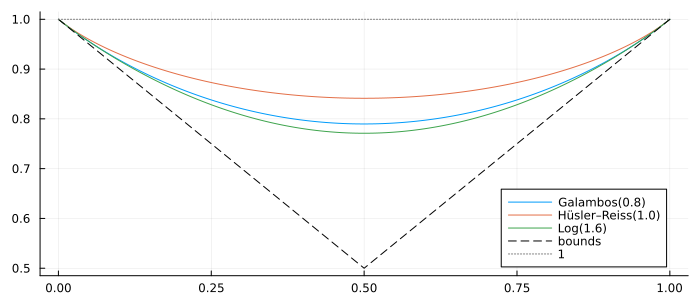
Sample scatter (uniform scale)
C = GalambosCopula(2, 1.0)
plot(C, title="Galambos copula sample")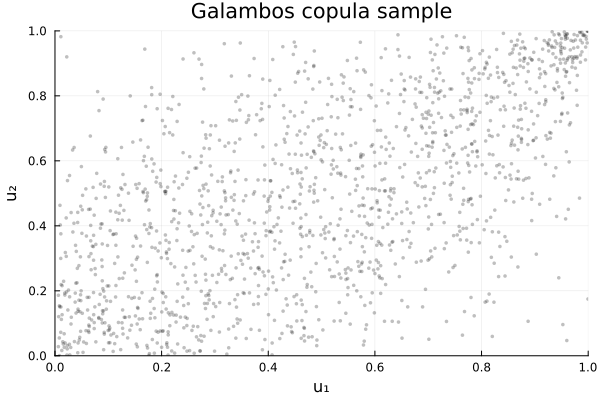
Conditional distortion (EV example)
C = HuslerReissCopula(2, 1.2)
u2 = 0.4
D = condition(C, 2, u2)
ts = range(0.0, 1.0; length=401)
plot(ts, cdf.(Ref(D), ts); xlabel="u", ylabel="H_{1|2}(u|u₂=0.4)",
     title="Conditional distortion for Hüsler–Reiss")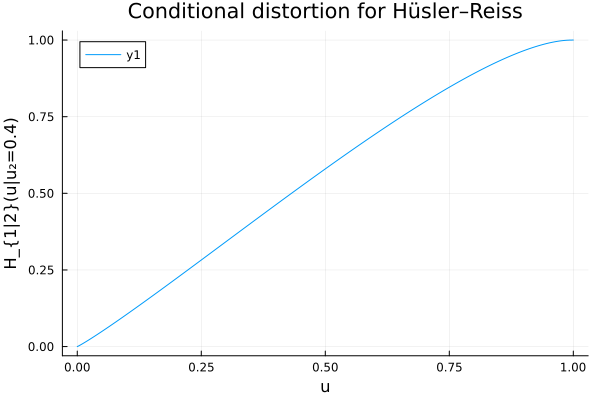
Rosenblatt sanity check (EV)
using StatsBase
U = rand(C, 2000)
S = reduce(hcat, (rosenblatt(C, U[:, i]) for i in 1:size(U,2)))
ts = range(0.0, 1.0; length=401)
EC = [ecdf(S[k, :]) for k in 1:2]
plot(ts, ts; label="Uniform", color=:blue, alpha=0.6, size=(650,300))
plot!(ts, EC[1].(ts); seriestype=:steppost, label="s₁", color=:black)
plot!(ts, EC[2].(ts); seriestype=:steppost, label="s₂", color=:gray)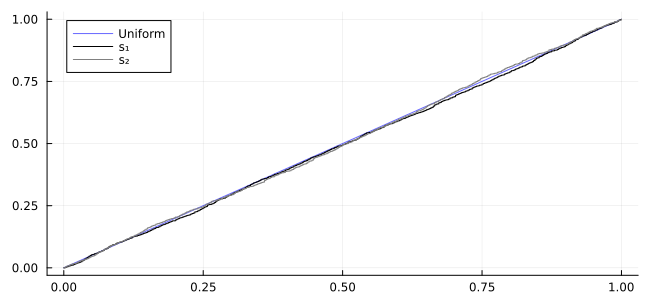
Available models
An extreme-value copula is determined by
| Model | Mathematical definition and parameter domain | Public constructors |
|---|---|---|
| Logistic | LogTail(θ); LogCopula{d}(θ); LogCopula(d, θ) | |
| Galambos | GalambosTail(θ); GalambosCopula{d}(θ); GalambosCopula(d, θ) | |
| Mixed | MixedTail(θ); MixedCopula{d}(θ); MixedCopula(d, θ) | |
| Cuadras–Augé | CuadrasAugeTail(θ); CuadrasAugeCopula{d}(θ); CuadrasAugeCopula(d, θ) | |
| Hüsler–Reiss | Brown–Resnick/Hüsler–Reiss STDF determined either by the exchangeable variogram | HuslerReissTail(θ) / HuslerReissTail(Γ); HuslerReissCopula{d}(θ) / HuslerReissCopula(Γ) |
| extremal- | extremal- | tEVTail(ν, ρ) / tEVTail(ν, R); tEVCopula{d}(ν, ρ) / tEVCopula{d}(ν, R) / runtime-dimension forms |
| Tawn asymmetric logistic | sum of logistic STDF components over nonempty coordinate subsets; non-singleton dependence parameters satisfy | TawnTail(α, weights) / TawnTail(d, dep, asy); corresponding TawnCopula forms |
| Asymmetric Galambos | sum of negative-logistic components over coordinate subsets; | AsymGalambosTail(α, weights) / AsymGalambosTail(dep, asy); corresponding AsymGalambosCopula forms |
| Asymmetric logistic (bivariate) | AsymLogTail(α, θ₁, θ₂); AsymLogCopula{2}(α, θ₁, θ₂); AsymLogCopula(2, α, θ₁, θ₂) | |
| Asymmetric mixed (bivariate) | AsymMixedTail(θ₁, θ₂); AsymMixedCopula{2}(θ₁, θ₂); AsymMixedCopula(2, θ₁, θ₂) | |
| BC2 spectral | two-atom spectral model; in dimension two | BC2Tail(a, b) / BC2Tail(a_vector); corresponding BC2Copula forms |
| Marshall–Olkin | common-shock model with one non-negative intensity for every nonempty subset of coordinates; the vector therefore has length | MOTail(λ₁, λ₂, λ₁₂) / MOTail(λ); corresponding MOCopula forms |
| Empirical EV (bivariate) | shape-constrained estimate of | EmpiricalEVTail(U; method=:ols); EmpiricalEVCopula{2}(U; method=:ols) |
| Empirical EV (multivariate) | finite spectral projection defining a valid homogeneous convex STDF | EmpiricalEVMultivariateTail(U; method=:ols, degree=3); EmpiricalEVCopula{d}(U; method=:ols, degree=3) |
Symmetric parametric models
Logistic. This is the extreme-value form of the Gumbel copula. The parameter increases monotonically from independence at
Galambos. Galambos is the negative-logistic extreme-value family, despite describing positive upper-tail association. Zero is independence and infinity is the comonotonic limit; bivariately,
Mixed. The bivariate Pickands curve interpolates linearly between independence and the Galambos model with parameter one, giving
Cuadras–Augé. This family is a direct mixture, at the STDF level, of independence and comonotonicity. The endpoints
Gaussian and Student extremal models
Hüsler–Reiss. The scalar constructor uses an exchangeable variogram
Extremal-
Asymmetric subset models
Tawn. Tawn decomposes the STDF into logistic components attached to coordinate subsets. The dependence parameters control each active subset, whereas the asymmetry weights allocate its contribution among margins; the per-margin normalization is essential for uniform margins. The compact (α, weights) constructor retains only a full-set component plus singleton remainders, while (dep, asy) is the full subset model—these forms should not be assumed to have the same number of free parameters.
Asymmetric Galambos. This is the analogous subset construction with negative-logistic components. Zero dependence parameters deactivate the corresponding components; an infinite full-set parameter reaches comonotonicity only when its weights are all one and no competing subset is active. As with Tawn, the ordering of dep and asy follows the documented nonempty-subset convention, so constructing long vectors manually is prone to indexing mistakes.
Asymmetric logistic. The bivariate parameters
Asymmetric Mixed. Its feasible parameter set is the quadrilateral defined by the four inequalities in the table, not a rectangular box. Independent unconstrained bounds on
Discrete spectral and empirical models
BC2. BC2 is most naturally understood through its two spectral atoms, not as two independent “strength” parameters. The parameters must produce a valid spectral measure with the required marginal moments, and relabeling the atoms can give equivalent descriptions. Discrete spectral mass may create singular components, so users should rely on the generalized distribution interface rather than assume a globally smooth density.
Marshall–Olkin. Each parameter is the intensity of a shock hitting one specific nonempty subset of margins. Simultaneous shocks generate singular mass and are precisely the feature of the model, not a numerical artifact. Multiplying every intensity by the same positive constant leaves the copula unchanged, so only relative rates are identifiable; zero rates are allowed, but every margin still needs positive total shock intensity.
Bivariate empirical EV. Pickands, CFG, and OLS are different estimators of the same Pickands curve and need not agree in finite samples. The fitted curve is projected to satisfy the shape constraints, so it is not simply the raw pointwise estimate. Grid resolution and endpoint trimming affect numerical accuracy, and pseudo_values=false must be used when the input has not already been transformed to ranks.
Multivariate empirical EV. The higher-dimensional estimator projects onto a finite spectral basis; degree trades approximation flexibility against optimization cost and potential instability. The result supports cdf and sampling but can contain singular components, so no global Lebesgue pdf is promised. Reproducibility and fit quality should be assessed together with the agreement between the fitted tail and the empirical target on a diagnostic grid, rather than from the constructor succeeding alone.
The canonical Public API documents complete call forms, validation, limiting cases, and numerical restrictions.
References
J. A. Tawn. Modelling multivariate extreme value distributions. Biometrika 77, 245–253 (1990).
H. Joe. Families of min-stable multivariate exponential and multivariate extreme value distributions. Statistics & probability letters 9, 75–81 (1990).
J. A. Tawn. Bivariate extreme value theory: models and estimation. Biometrika 75, 397–415 (1988).
J. Galambos. Order statistics of samples from multivariate distributions. Journal of the American Statistical Association 70, 674–680 (1975).
G. Gudendorf and J. Segers. Nonparametric estimation of an extreme-value copula in arbitrary dimensions. Journal of multivariate analysis 102, 37–47 (2011).
G. Gudendorf and J. Segers. Nonparametric estimation of multivariate extreme-value copulas. Journal of Statistical Planning and Inference 142, 3073–3085 (2012).
K. Ghoudi, A. Khoudraji and E. L.-P. Rivest. Propriétés statistiques des copules de valeurs extrêmes bidimensionnelles. Canadian Journal of Statistics 26, 187–197 (1998).
P. Deheuvels. On the limiting behavior of the Pickands estimator for bivariate extreme-value distributions. Statistics & Probability Letters 12, 429–439 (1991).