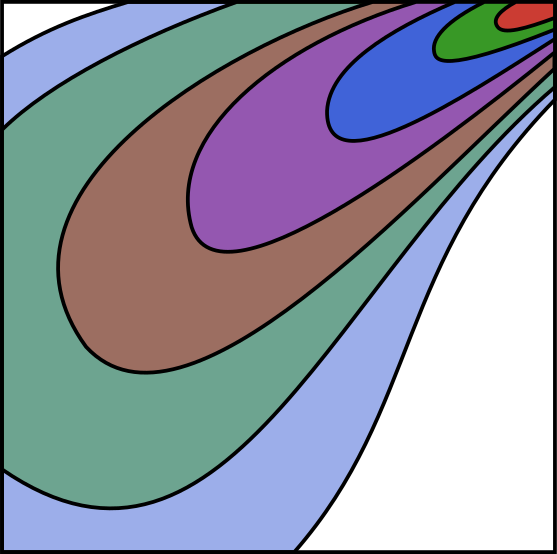
Vines family
One notable class of copulas is the vine copulas. These distributions use a graph of conditional distributions to encode the distribution of the random vector. To define such a model, working with conditional densities, and given any ordered partition
Of course, the choice of partition, its order, and the conditional models is left to the practitioner. The goal when dealing with such dependency graphs is to tailor the graph to reduce the approximation error, which can be a challenging task. There exist simplifying assumptions that help with this, and we refer to [, –] for a deep dive into vine theory, along with results and extensions.
Vine copulas are available through the add-on package VineCopulas.jl, which is built on top of Copulas.jl. It provides explicit C-vine, D-vine, and regular-vine models, with density evaluation, simulation, Rosenblatt transforms, pair-copula conditional primitives, and R-vine matrix helpers. See the VineCopulas.jl documentation for the full API and current scope.
A small D-vine example
using Copulas, VineCopulas

C12 = GaussianCopula([1.0 0.5; 0.5 1.0])
C23 = ClaytonCopula(2, 2.0)
C13_2 = FrankCopula(2, 3.0)

vine = DVineCopula([1, 2, 3], [[C12, C23], [C13_2]])
The obtained object is a genuine copula, with (at least) the same API described here. See the VineCopulas.jl documentation for the full API and current scope.
References
C. Czado. Analyzing Dependent Data with Vine Copulas: A Practical Guide With R. Vol. 222 of Lecture Notes in Statistics (Springer International Publishing, Cham, 2019).
F. Durante, G. Puccetti, M. Scherer and S. Vanduffel. The Vine Philosopher. Dependence Modeling 5, 256–267 (2017).
T. Nagler and C. Czado. Evading the Curse of Dimensionality in Nonparametric Density Estimation with Simplified Vine Copulas. Journal of Multivariate Analysis 151, 69–89 (2016).
T. Nagler. Nonparametric Estimation in Simplified Vine Copula Models. Ph.D. Thesis, Technische Universität München (2018).
C. Czado, S. Jeske and M. Hofmann. Selection Strategies for Regular Vine Copulae. Journal de la Société Française de Statistique 154, 174–191 (2013).
B. Gräler. Modelling Skewed Spatial Random Fields through the Spatial Vine Copula. Spatial Statistics 10, 87–102 (2014).