Influence of the method of estimation
The ability to fit the copula and marginals directly through the SklarDist interface is very practical for quickly fitting a model to a dataset. It works as follows:
using Copulas, Distributions
X₁ = Normal()
X₂ = LogNormal()
X₃ = Gamma()
C = GaussianCopula([
    1.0 0.4 0.1
    0.4 1.0 0.8
    0.1 0.8 1.0
])
D = SklarDist(C,(X₁,X₂,X₃))
x = rand(D,100)
3×100 Matrix{Float64}:
1.38058 0.622597 -0.807682 … 2.05394 -0.324582 -0.883247
2.04729 0.315294 1.03856 1.55075 5.25052 0.832396
0.523708 0.00981653 1.14239 0.421124 2.46175 0.277786And we can fit the same model directly as follows:
quick_fit = fit(SklarDist{GaussianCopula, Tuple{Normal,LogNormal,Gamma}}, x)SklarDist{GaussianCopula{3, Float64}, Tuple{Distributions.Normal{Float64}, Distributions.LogNormal{Float64}, Distributions.Gamma{Float64}}}(
C: GaussianCopula{3, Float64}(Σ = [1.0 0.4668487490688693 0.24274780963138076; 0.4668487490688693 1.0000000000000002 0.7997477876708619; 0.24274780963138076 0.7997477876708619 1.0000000000000002]))
m: (Distributions.Normal{Float64}(μ=0.005605927211775285, σ=0.9472405640408279), Distributions.LogNormal{Float64}(μ=0.12112505160640451, σ=0.9961665497882979), Distributions.Gamma{Float64}(α=0.9206257358767396, θ=1.263769937754109))
)However, we should clarify what this is doing. There are several ways of estimating compound parametric models:
Joint estimation (JMLE): This method simply computes the joint log-likelihood
of the random vector Dand maximizes, jointly, with respect to the parameters of the dependence structure and the marginals. This is the easiest to understand, but not the easiest numerically, as the resulting log-likelihood can be highly non-linear and computations can be tedious.Inference functions for margins (IFM): This method splits the process into two parts: the marginal distributions
are estimated first, separately, through maximum likelihood on marginal data. Denote these estimators. Then, we fit the copula on pseudo-observations, which can be computed in two ways: IFM1: Use empirical ranks to compute the pseudo-observations.
IFM2: Use the estimated distribution functions
for the marginals to compute the pseudo-observations as .
The documented fit(SklarDist{...}, ...) operation first fits each margin, forms empirical pseudo-observations, and then fits the requested copula family. It therefore performs IFM1 estimation. The concrete dispatch and storage types used to implement these steps are internal. IFM2 can be assembled from the same public operations as follows:
# Marginal fits are the same than IFM1, so we just used those to compute IFM2 ranks:
u = similar(x)
for i in 1:length(C)
    u[i,:] .= cdf.(Ref(last(params(quick_fit))[i]), x[i,:])
end

# estimate a Gaussian copula:
ifm2_cop = fit(GaussianCopula,u)
GaussianCopula{3, Float64}(Σ = [1.0 0.4668487490688693 0.24274780963138076; 0.4668487490688693 1.0000000000000002 0.7997477876708619; 0.24274780963138076 0.7997477876708619 1.0000000000000002]))Let us compare the two obtained correlation matrices:
only(params(ifm2_cop)) .- only(params(first(params(quick_fit))))3×3 Matrix{Float64}:
0.0 0.0 0.0
0.0 0.0 0.0
0.0 0.0 0.0We see that the estimated parameter is not exactly the same, which is normal. Even in this contrived example, the difference between the two is not striking. Whether one method is better than the other is unclear, but the JMLE method is clearly superior by definition. However, due to its complexity, most software do not perform such estimation.
using Plots, StatsBase
P1 = scatter(x[1,:], x[2,:]; ms=2, alpha=0.6, title="Original scale (first two dims)", legend=false)
U1 = pseudos(x)
P2 = scatter(U1[1,:], U1[2,:]; ms=2, alpha=0.6, xlim=(0,1), ylim=(0,1), title="Pseudo-observations (IFM1)", legend=false)
plot(P1, P2; layout=(1,2), size=(850,350))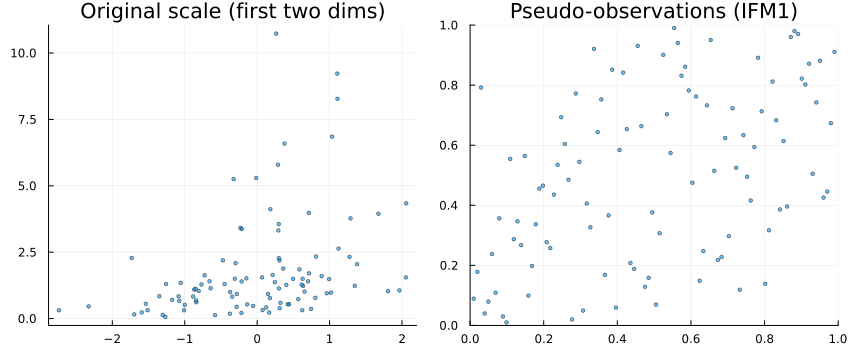
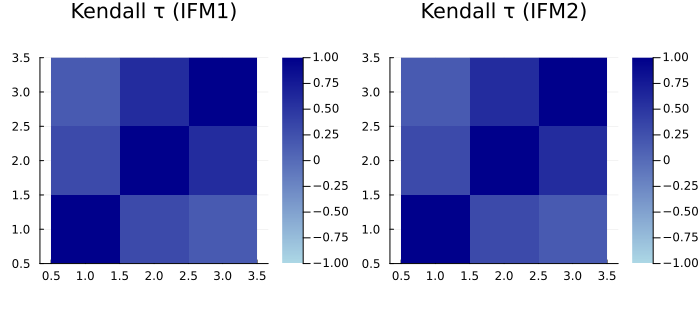
τ1 = StatsBase.corkendall(U1')
U2 = similar(x)
for i in 1:length(C)
    U2[i,:] .= cdf.(Ref(last(params(quick_fit))[i]), x[i,:])
end
τ2 = StatsBase.corkendall(U2')
plot(heatmap(τ1; title="Kendall τ (IFM1)", aspect_ratio=1, c=:blues, clim=(-1,1)),
     heatmap(τ2; title="Kendall τ (IFM2)", aspect_ratio=1, c=:blues, clim=(-1,1)),
     layout=(1,2), size=(700,320))